
Blog

All Hamilton Law Service Alimony Divorce Family Law personal injury
in Hamilton Law Service

When Should You Hire a Lawyer After a Slip-and-Fall Injury in Las Vegas?

A slip-and-fall accident can happen in seconds, but the effects can last for months or even years. Injuries caused by unsafe property conditions may result in medical expenses, lost wages, physical limitations, and emotional stress. If your fall occurred because a property owner, business, landlord, or another party failed to maintain safe conditions, you may have the right to pursue a personal injury claim under Nevada law. Speaking with a Las Vegas slip and fall lawyer can help you understand your options, protect important evidence, and determine whether another party may be legally responsible. Hamilton Law represents injured individuals throughout Las Vegas and helps clients understand their rights after accidents involving unsafe property conditions. If you were injured in a slip-and-fall accident, call 702-472-8160 or contact Hamilton Law to discuss your situation. more When Should You Hire a Las Vegas Slip and Fall Lawyer? Not every fall results in a legal claim, but certain situations make it especially important to speak with an attorney. Property owners and insurance companies often focus on limiting their financial responsibility, making it important to understand your rights before accepting a settlement or making statements about the accident. 1. When You Suffer Serious Injuries or Significant Medical Expenses If your slip-and-fall accident resulted in serious injuries, seeking legal guidance may be an important step in protecting your claim. Some common injuries associated with slip-and-fall accidents include: Broken bones and fractures Head injuries Spinal injuries Soft tissue injuries Ligament damage Long-term mobility limitations Medical treatment after a fall can become expensive quickly. You may also miss work while recovering, resulting in lost income and additional financial pressure. Insurance companies may attempt to resolve claims quickly, sometimes before the full extent of your injuries and future medical needs are known. A Las Vegas personal injury attorney can help evaluate damages that may include medical expenses, lost wages, and other losses connected to your accident. Hamilton Law helps injured clients understand the claims process and available legal options. To discuss your circumstances, call 702-472-8160 or schedule a consultation through the Hamilton Law contact page. 2. When the Property Owner or Insurance Company Denies Responsibility One of the biggest challenges in a slip-and-fall case is proving that another party was responsible for creating or failing to correct a dangerous condition. A property owner, business, or insurance company may argue that: They were not aware of the hazard The dangerous condition existed for only a short time Warning signs were posted The injured person should have noticed the hazard The injured person was responsible for causing the accident Under Nevada premises liability law, property owners and businesses generally have a responsibility to maintain reasonably safe conditions for lawful visitors. However, proving negligence often requires evidence showing how the dangerous condition occurred and whether the property owner had notice of the hazard. Evidence that may be important in a slip-and-fall claim includes: Surveillance footage Incident reports Photos of the hazardous condition Witness statements Maintenance records Medical documentation Hamilton Law can help investigate the circumstances surrounding your accident and determine what evidence may support your claim. Contact the firm at 702-472-8160 or reach out through Hamilton Law’s contact page to discuss your case. 3. When Liability Is Unclear Slip-and-fall cases are not always straightforward. Multiple parties may potentially share responsibility depending on where and how the accident occurred. For example, liability may involve: A retail store owner A property management company A landlord A business tenant A maintenance company Another responsible party Determining who may be legally responsible requires reviewing the facts of the accident, ownership records, maintenance responsibilities, and applicable Nevada law. Nevada follows a comparative negligence system under Nevada Revised Statutes Chapter 41, which means an injured person’s compensation may be reduced if they are found partially responsible for their injuries. However, an injured person may still be able to recover damages if their percentage of fault does not exceed the applicable legal threshold. Because insurance companies may attempt to place blame on the injured person, having legal guidance can help protect your ability to pursue fair compensation. 4. When You Need Help Dealing With Insurance Companies After a slip-and-fall accident, insurance companies may request statements, medical records, or documentation related to your injuries. While insurers may appear helpful, their goal is often to resolve claims while minimizing costs. Before accepting a settlement offer or signing documents, it may be helpful to understand: Whether the offer reflects your current and future losses Whether additional medical treatment may be needed Whether your legal rights could be affected Whether another party may be responsible A Las Vegas slip and fall lawyer can review your situation and help you understand the potential value and challenges of your claim. Hamilton Law provides guidance for individuals injured due to unsafe property conditions. Call 702-472-8160 or contact Hamilton Law online to learn how your case may be evaluated. 5. When Important Evidence Could Be Lost Evidence is often critical in premises liability cases. Security footage may be overwritten, hazardous conditions may be repaired, and witness memories may fade. Taking action early can help preserve important information related to: The condition that caused the fall How long the hazard existed Whether employees or owners knew about the condition Whether proper safety procedures were followed A personal injury attorney can help identify what evidence may be needed to support your claim and communicate with responsible parties on your behalf. Nevada Slip-and-Fall Claims Require Careful Evaluation A slip-and-fall accident may seem simple, but proving negligence often requires examining several factors, including: Who controlled the property Whether a dangerous condition existed Whether the responsible party knew or should have known about the hazard Whether reasonable steps were taken to correct the condition Whether the injured person contributed to the accident Each case depends on its specific facts. Speaking with a qualified attorney can help you understand how Nevada law applies to your circumstances. Hamilton Law handles personal injury matters involving accidents caused by unsafe property conditions. Learn more about your options by reviewing the firm’s personal injury services or information about slip-and-fall and premises liability claims. Contact a Las Vegas Slip and Fall Lawyer at Hamilton Law If you were injured in a slip-and-fall accident caused by unsafe property conditions, taking action early may help protect your legal rights. A thorough review of your accident can help determine whether another party may be responsible for your injuries and losses. Hamilton Law helps Las Vegas injury victims understand their options after accidents involving negligence and unsafe premises. Call 702-472-8160 today or contact Hamilton Law to discuss your potential claim. Suggested FAQ Schema Questions Q: How long do I have to file a slip-and-fall claim in Nevada? A: Nevada generally has a two-year statute of limitations for personal injury claims, but deadlines may vary depending on the circumstances. Speaking with an attorney can help determine the applicable deadline for your situation. Q: What must I prove in a Nevada slip-and-fall case? A: You generally must show that a dangerous condition existed, the responsible party knew or should have known about the condition, and the condition contributed to your injuries. Q: Can I still recover compensation if I was partially at fault for my fall? A: Nevada follows comparative negligence rules, which may allow recovery depending on the percentage of fault assigned. Q: What should I do after a slip-and-fall accident in Las Vegas? A: Seek medical attention, document the scene if possible, report the incident, gather witness information, and consider speaking with a personal injury attorney. Q: How much is a slip-and-fall case worth in Nevada? A: The value depends on factors such as injury severity, medical expenses, lost income, liability, and available evidence. Each claim must be evaluated individually.

Read More
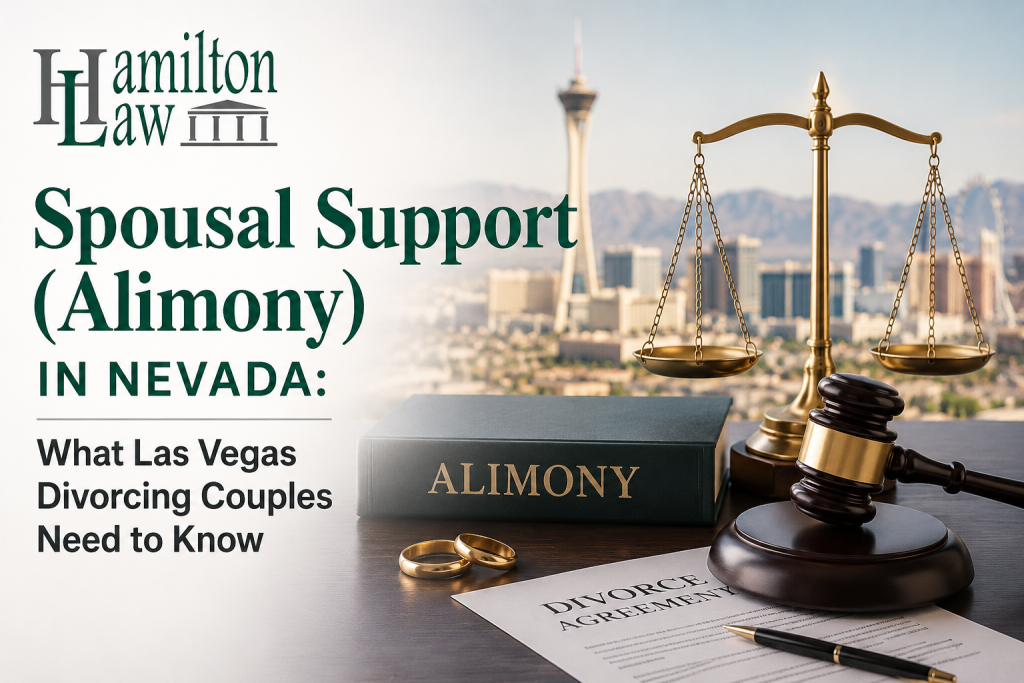
Legal Gavel and scale with a book with the words alimony and the text Spousal Support (Alimony) In Nevada.

Spousal Support (Alimony) in Nevada: What Las Vegas Divorcing Couples Need to Know

Divorce often brings uncertainty about finances, especially when one spouse has earned significantly more income or sacrificed career opportunities during the marriage. One of the most common questions people ask during a divorce is whether they will have to pay alimony or if they qualify to receive it. In Nevada, spousal support, commonly called alimony, is not automatically awarded. Courts carefully examine several factors before determining whether support is appropriate, how much should be paid, and how long payments should continue. Understanding how Nevada courts approach alimony can help you make informed decisions and protect your financial future. Nevada courts generally consider factors such as the length of the marriage, the income and earning capacity of each spouse, and the financial needs of both parties when evaluating spousal support requests. If you are facing a divorce in Las Vegas, Henderson, Summerlin, North Las Vegas, or elsewhere in Clark County, the family law attorneys at Hamilton Law can help you understand your rights and options. Call 702-472-8160 or visit the contact page to schedule a consultation. What Is Spousal Support in Nevada? Spousal support is a court-ordered payment from one spouse to another during or after a divorce. The purpose is to help address financial imbalances that may result from the end of a marriage. In some situations, support may be awarded temporarily while the divorce is pending. In other cases, support may continue after the divorce is finalized. Nevada courts have broad discretion when determining whether alimony is appropriate because there is no strict formula that automatically calculates payments. Each case is evaluated based on its unique circumstances. Common Terms You May Hear Spousal support Alimony Temporary spousal support Rehabilitative alimony Long-term alimony Post-divorce support While these terms are often used interchangeably, they may describe different stages or purposes of financial support during and after a divorce proceeding. Is Alimony Automatic in Las Vegas Divorce Cases? No. Nevada courts do not automatically award alimony simply because a couple is divorcing. Instead, judges review the financial circumstances of both spouses to determine whether support is appropriate. Factors such as income disparity, the duration of the marriage, each spouse's earning potential, and financial needs all play a role in the court's decision. Hamilton Law notes that spousal support is determined by factors including the length of the marriage, income differences, and each spouse's financial circumstances. Because every family situation is different, two divorces with similar incomes can result in very different support outcomes. Factors Nevada Courts Consider When Awarding Alimony When determining whether spousal support should be awarded, Nevada courts may evaluate several important factors, including: Length of the Marriage Generally, longer marriages are more likely to result in spousal support awards. A spouse who spent many years supporting the family or raising children may need financial assistance while adjusting to post-divorce life. Income and Earning Capacity Courts often compare each spouse's current income and future earning potential. If one spouse has significantly greater financial resources, support may be considered. Standard of Living During the Marriage Judges may review the lifestyle established during the marriage and consider whether support is necessary to help maintain a reasonable standard of living. Contributions to the Marriage Contributions are not limited to income. Courts may also consider: Raising children Managing the household Supporting a spouse's education or career advancement Sacrificing personal career opportunities Age and Health Physical or mental health conditions that affect a spouse's ability to work may influence alimony decisions. Education and Employment History A spouse who has been out of the workforce for years may require additional support while obtaining education, training, or employment opportunities. Types of Spousal Support in Nevada Temporary Spousal Support Temporary support may be awarded while the divorce is pending. Its purpose is to help maintain financial stability until the court enters a final divorce decree. Rehabilitative Alimony This form of support helps a spouse gain the education, training, or work experience necessary to become financially independent. Examples include: College tuition Vocational training Professional certifications Job placement assistance Long-Term Alimony Long-term or ongoing support may be awarded in marriages where one spouse is unlikely to become fully self-supporting due to age, disability, or other circumstances. Lump-Sum Alimony In some cases, spouses may negotiate a single payment rather than ongoing monthly support obligations. How Long Does Alimony Last in Nevada? There is no universal answer. The duration of alimony depends on factors such as: Length of the marriage Age of the spouses Financial circumstances Employment opportunities Health conditions Whether the receiving spouse can become self-supporting Shorter marriages often result in shorter support periods, while longer marriages may justify longer-term obligations. Can Alimony Be Modified? Yes. In many cases, spousal support orders can be modified when substantial changes in circumstances occur. Examples include: Significant income increases or decreases Job loss Serious illness or disability Retirement Changes in financial needs Hamilton Law assists clients seeking post-divorce modifications when significant financial changes impact existing support orders. If your circumstances have changed, it is important to seek legal guidance before simply stopping or reducing payments. What Happens If Someone Does Not Pay Court-Ordered Alimony? Failure to comply with a court-ordered support obligation can result in serious legal consequences. Potential enforcement actions may include: Wage garnishment Property liens Asset seizure Contempt proceedings Additional court penalties Courts generally expect compliance with support orders unless a modification is formally approved. How Alimony and Property Division Work Together Many people assume that alimony and property division are separate issues. In reality, they often influence one another. During divorce negotiations, courts and attorneys frequently evaluate: Community property division Retirement accounts Real estate ownership Business interests Debts and liabilities Spousal support obligations A well-structured divorce settlement considers the complete financial picture rather than focusing solely on monthly support payments. Negotiating a Fair Spousal Support Agreement Many alimony disputes can be resolved through negotiation rather than litigation. Effective negotiations often involve: Reviewing financial disclosures Analyzing income sources Evaluating future earning capacity Considering tax implications Identifying long-term financial goals An experienced Las Vegas divorce attorney can help ensure that any agreement is realistic, enforceable, and designed to protect your interests. Why Legal Representation Matters in Alimony Cases Spousal support disputes often involve complex financial issues that can significantly impact your future. Whether you are seeking support or defending against an unreasonable request, legal representation can help you: Protect your financial interests Gather necessary documentation Present evidence effectively Negotiate favorable settlements Pursue modifications when circumstances change Enforce court orders when necessary At Hamilton Law, we help clients throughout Las Vegas and Clark County navigate divorce and post-divorce issues with personalized legal guidance. Our family law team assists clients with divorce, child custody matters, and post-divorce modifications to help them achieve fair outcomes. Speak With a Las Vegas Divorce Attorney About Spousal Support Questions about alimony can affect your financial future for years after a divorce is finalized. Whether you are concerned about paying support, receiving support, or modifying an existing order, obtaining legal guidance early can make a significant difference. Hamilton Law proudly serves clients throughout Las Vegas, Summerlin, Henderson, North Las Vegas, and surrounding Clark County communities. Our office is conveniently located at 5125 S. Durango Drive, Las Vegas, NV 89113. We provide personalized family law representation designed to help clients move forward with confidence. Call 702-472-8160 today or contact us online to schedule a consultation. For additional information about divorce and family law services visit our website.

Hit By a Semi-Truck? Here’s What Insurance Companies Hope You Never Learn

If you’ve been in a crash with a semi-truck, you’re probably already getting calls from insurance companies. They may sound helpful. They may even sound concerned. Here’s the truth: their goal is not to protect you — it’s to protect their bottom line. When it comes to semi-truck accidents in Nevada, there are critical facts they hope you never find out. Car accidents are stressful enough — but when a semi-truck is involved, everything changes. The injuries are often more severe, the legal issues more complex, and the stakes are much higher. If you or someone you love has been hit by a commercial truck in Nevada, understanding these differences can make or break your case. Call Hamilton Law today at (702) 818-1818 for your FREE consultation! The First Thing No One Tells You: This Isn’t a Normal Case Insurance companies want you to believe your case is just like any other car accident. It’s not. Semi-trucks in Nevada must comply with a combination of state laws, administrative codes, and federal regulations to ensure safety, legal operation, and compliance with transportation laws. For semi-truck drivers, there are more rules to follow and a whole lot of people who are held responsible for incidents like these. Commercial drivers must comply with specific restrictions, including hours-of-service limits (to prevent fatigue), routine inspection requirements, maintenance and repair standards, age limits and mental/ physical testing, cargo weight enforcement, and so on. Violations of these rules can establish negligence, a very powerful legal argument in your case. The Biggest Differences in Semi-Truck Accident Cases Semi-truck accidents are not just bigger car crashes — they are completely different cases, and insurance companies count on you to not know that. Unlike a typical accident involving two drivers, a truck collision can involve multiple responsible parties, including the driver, the trucking company, maintenance providers, and even those responsible for loading the cargo — meaning there may be more than one source of compensation for you to seek. These cases also involve stricter safety rules and industry regulations that don’t apply to everyday drivers, which can strengthen your claim if violations are uncovered. Add to that the sheer size of commercial trucks — up to 80,000 pounds —resulting in more severe injuries and higher-value claims, along with significantly larger insurance policies, and the stakes become much higher. With more money on the line comes more aggressive defense, and critical evidence like black box data and driver logs can disappear quickly if you don’t act fast. Making these cases more complex, more urgent, and far more serious from the very beginning. It’s important that you contact an attorney as soon as you can dial a phone. The Trap: Friendly Adjusters and Fast Settlements Insurance companies often move quickly after a semi-truck accident, reaching out with a friendly tone and what may seem like a helpful offer to resolve your claim. But what feels like cooperation is often a calculated strategy. Early settlement offers are typically far lower than what your case is truly worth, especially before the full extent of your injuries is known. At the same time, they may ask for a recorded statement, framing it as routine. When in reality, your words can later be used to minimize or deny your claim. The goal is simple: resolve your case quickly, limit their financial expenses, and close the file before you fully understand your rights. What appears to be a step forward can actually be one of the most damaging moments in your case if you’re not properly protected. Play it Smart, Call Hamilton Law! At the end of the day, no one plans to get into an accident, especially not with something the size of a moving building. But if it happens, knowing the difference between a regular car crash and a semi-truck accident can save you a lot of stress, time, and money. Think of it this way: when the situation gets bigger, so do the stakes —and you deserve someone in your corner who knows how to handle it. So before you sign anything, agree to anything, or let the insurance company take the lead, take a breath and make sure you’re protected. And if you want a team that knows how to navigate the road ahead (and make the process a little less overwhelming along the way), give Hamilton Law a call at 702-818-1818 for a FREE consultation today!

They Charged you with a Financial Crime, Now What?

Getting charged with a financial crime can feel overwhelming. These cases are often complex, document-heavy, and aggressively prosecuted in Nevada. But here’s the good news: being charged is not the same as being convicted, and there are strategic steps you can take immediately to protect yourself. At Hamilton Law, we have helped numerous clients navigate these high-stakes situations. Here’s what you need to know. Financial crimes —often called “white collar crimes”— typically involve money, deception, or breach of trust. To understand what a financial crime is, let’s look at some examples: Bribery (see NRS 197.020): Offering or receiving something of value to influence official action. Theft / Larceny (NRS 205.0832): Unlawful taking of another’s property. Cybercrime / Computer Crimes (NRS 205.4765): Unauthorized access, hacking, data theft. Money Laundering (NRS 207.195): Concealing the source of illegal funds. Tax Evasion / Fraudulent Financial Reporting: Deliberate act of avoiding taxes owed to the government through deceptive or fraudulent means. Counterfeiting (NRS 205.160): Forgery or imitation of currency/documents. Embezzlement (NRS 205.300): Misappropriation of entrusted funds. These charges can range from gross misdemeanors to serious felonies, often carrying prison time, steep fines, and restitution obligations. What Are the Penalties for These Crimes? No matter how much you loved the movie Wolf of Wall Street, the real story behind these types of crimes involves lengthy investigations, intense charges, and consequences that can follow you for years. White-collar crimes are rigorously prosecuted in Nevada. Cases like these are held under a microscope and the State will check every nook and cranny to prove you are guilty. Penalties can vary widely depending on the charge and the amount of money involved, but may include: Felony convictions Prison sentences Restitution (paying back alleged losses) Fines and court fees Permanent criminal record For example, under NRS 205.0835, theft penalties increase significantly based on the value involved—ranging from misdemeanors to Category B felonies. Let’s Get Down to Business Here’s the reality: by the time you’re charged with a financial crime, the State is already several steps ahead. This is not the moment to “wait and see.” It’s the moment to act strategically—and it starts with understanding your next move. Let’s go over what steps to take when you’re accused of a financial crime. Step 1: Do NOT Speak to Investigators Without an Attorney Law enforcement and investigators may seem friendly — but their job is to build a case against you. Even innocent explanations can be misunderstood or used out of context. If someone tries to contact you about something you’re being accused of, politely decline to answer until you have a lawyer present. Seriously. Any information you give to investigators is recorded and can be used against you at any time. No matter how pressured or nervous you feel, be respectful and invoke your Fifth Amendment right to stay silent. As a good rule of thumb, do NOT discuss your case with any friends, coworkers, or even family members. The State prosecutors will look for any way to find you guilty. Voice your comments and concerns under the privacy privilege that your lawyer has a duty to keep. Anyone who has any knowledge of the charges being held against you will be investigated thoroughly. Step 2: Keep ALL Your Financial Documents Together Financial crime cases are built on paper trails — bank records, emails, contracts, invoices, and digital communications. Any paperwork or electronic documentation that relates to the charge must be preserved. Do NOT delete emails or files, alter financial records or dispose of any device that holds information being investigated. In Nevada, destroying evidence can lead to additional charges or negatively impact your defense. Step 3: Hire a Defense Attorney with Experience in Financial Crimes Financial cases are not like typical criminal cases — they often involve forensic accounting, digital evidence analysis, and complex statutory interpretation. An experienced Nevada attorney can: Challenge how any evidence was obtained Identify weaknesses in the State’s case Negotiate for reduced charges or dismissal Our firm takes these cases earnestly. We move swiftly to protect your rights. The attorneys here explain very clearly what charges are being made and how we plan to defend the case. Put your trust in a firm that prioritizes guiding you through every step with clarity, care, and confidence. At Hamilton Law, our legal team understands how to break down complex financial cases and build strong, strategic defenses tailored to Nevada law. Call Hamilton Law at (702) 818-1818 for a FREE consultation.

Acoso Sexual en el Lugar de Trabajo: Conozca Sus Derechos y Tome Acción

El trabajo debe ser un lugar donde usted se sienta seguro(a), respetado(a) y valorado(a). No un entorno incómodo, intimidante o en el que tenga miedo de expresarse. Desafortunadamente, el acoso sexual en el lugar de trabajo sigue siendo demasiado común. Muchas personas no se dan cuenta de lo grave que es, ni de qué pueden hacer al respecto. En Hamilton Law, recientemente representamos a una cliente que vivió exactamente esta situación. Nuestra cliente comenzó a recibir fotos explícitas no solicitadas de un compañero de trabajo—imágenes que nadie debería verse obligado(a) a recibir, especialmente en un entorno profesional. Ella hizo lo correcto: lo reportó. Pero nada cambió. El acoso continuó. El empleador no tomó medidas. Incluso después de que el compañero fuera arrestado por cargos no relacionados y despedido, posteriormente fue recontratado, y el acoso comenzó nuevamente. Nuestra cliente finalmente sintió que no tenía otra opción más que dejar su empleo, pero no guardó silencio. Decidió alzar la voz—no solo por ella, sino para proteger a otros de pasar por la misma experiencia. ¿El resultado? Un acuerdo de $90,000 por el cual luchamos. ¿Qué se Considera Acoso Sexual? El acoso sexual no siempre es evidente, ni se limita al contacto físico no deseado. Incluye: Envío de fotos o mensajes explícitos Comentarios o bromas sexuales no deseadas Solicitudes repetidas de citas o interacción personal Crear un ambiente laboral hostil o incómodo Represalias después de reportar conducta inapropiada Si una conducta le hace sentir incómodo(a), señalado(a) o inseguro(a) debido a su sexo o género, es importante y cuenta. Cuando los Empleadores No Actúan Los empleadores tienen la obligación legal de tomar en serio el acoso y responder adecuadamente. Cuando una empresa ignora quejas, retrasa acciones o permite que el acoso continúe, puede ser considerada legalmente responsable. En el caso de nuestra cliente: Ella reportó el acoso El empleador no intervino La conducta continuó—even después del despido y la recontratación Esa falta de acción creó un ambiente laboral hostil, lo que finalmente resultó en responsabilidad legal. ¿Cuáles Son las Consecuencias Legales? El acoso sexual puede dar lugar tanto a responsabilidad civil como a cargos penales, dependiendo de la conducta. Sanciones Civiles (Responsabilidad del Empleador) Las víctimas pueden tener derecho a: Compensación económica (como el acuerdo de $90,000 de nuestra cliente) Salarios perdidos o ingresos futuros Daños por angustia emocional Honorarios de abogados Sanciones Penales (Ley de Nevada) Ciertos actos relacionados con el acoso, especialmente aquellos que involucran imágenes explícitas, pueden constituir delitos penales, tales como: Exhibición obscena o conducta lasciva grave (NRS 201.210) – delito menor grave Acoso o acecho (NRS 200.571 / 200.575) Difusión ilegal de imágenes íntimas (NRS 200.780) – puede ser delito grave Las sanciones pueden incluir: Tiempo en la cárcel o prisión Multas Libertad condicional Antecedentes penales permanentes La gravedad de la sanción depende de los hechos, pero las consecuencias son reales. Qué Hacer Si Esto Le Ocurre Muchas víctimas dudan en reportar el acoso sexual por miedo a represalias, vergüenza o incertidumbre sobre si serán creídas. La verdad es esta: si le hace sentir incómodo(a), importa, y usted está protegido(a). Si está experimentando acoso sexual en el trabajo, tome las siguientes medidas: Documente todo (mensajes, fotos, fechas, testigos) Repórtelo internamente (recursos humanos o gerencia) No elimine evidencia Consulte con un abogado lo antes posible Mientras más pronto actúe, más sólido puede ser su caso. Usted no está solo(a), y tiene opciones para protegerse. Nuestra cliente no solo buscó justicia para sí misma; tomó una postura para prevenir daños futuros. Nadie debería tener que dejar su empleo para sentirse seguro(a). En Hamilton Law, tomamos estos casos con la máxima seriedad y respeto. Luchamos para responsabilizar a los empleadores y hacer que los lugares de trabajo sean más seguros para todos. CONTACTE A HAMILTON LAW Muchas personas minimizan conductas como bromas inapropiadas o mensajes indebidos, considerándolos “sin importancia”. El acoso a menudo comienza de forma sutil, pero luego se intensifica. Si usted o alguien que conoce está experimentando acoso sexual en el lugar de trabajo, NO espere. Llame a Hamilton Law al (702) 818-1818 para una consulta GRATUITA. ¡Su voz importa, y estamos aquí para ayudarle a usarla!

Sexual Harassment in the Workplace: Know Your Rights and Take Action

Work should be a place where you feel safe, respected, and valued. Not an environment that’s uncomfortable, intimidating, or where you’re afraid to speak up. Unfortunately, sexual harassment in the workplace is still far too common. Many people don’t realize just how serious it is — or what they can do about it. At Hamilton Law, we recently represented a client who experienced exactly this. Our client began receiving uninvited, explicit photos from a coworker — images no one should ever be forced to see, especially in a professional environment. She did the right thing: she reported it. But nothing changed. The harassment continued. The employer failed to act. Even after the coworker was arrested on unrelated charges and terminated, he was later rehired — and the harassment started again. Our client ultimately felt she had no choice but to leave her job, but she didn’t stay silent. She came forward—not just for herself, but to protect others from going through the same experience. The result? A $90,000 settlement that we fought for. What is Considered Sexual Harassment? Sexual harassment isn’t always obvious, and it’s not limited to unwanted physical contact. Sexual harassment includes: Sending explicit photos or messages. Unwanted sexual comments or jokes Repeated requests for dates or personal interaction Creating a hostile or uncomfortable work environment Retaliation after reporting inappropriate behavior If it makes you feel uncomfortable, targeted, or unsafe because of your sex or gender it matters. When Employers Fail to Act Employers have a legal obligation to take harassment seriously and respond appropriately. When a company ignores complaints, delays action, or allows harassment to continue, they may be held legally responsible. In our client’s case: She reported the harassment The employer failed to intervene The behavior continued — even after termination and rehiring That failure created a hostile work environment, which ultimately led to legal accountability. What Are the Legal Consequences? Sexual harassment can lead to both civil liability and criminal charges, depending on the conduct. Civil Penalties (Employer Liability) Victims may be entitled to: Financial compensation (like our client’s $90,000 settlement) Lost wages or future earnings Emotional distress damages Attorney’s fees Criminal Penalties (Nevada Law) Certain acts tied to harassment, especially involving explicit images, can rise to criminal offenses, such as: Open or gross lewdness (NRS 201.210) – a gross misdemeanor Harassment or stalking (NRS 200.571 / 200.575) Unlawful dissemination of intimate images (NRS 200.780) – can be a felony Penalties can include: Jail or prison time Fines Probation Permanent criminal record The severity of the penalty depends on the facts, but the consequences are real. What to Do If This Happens to You Many victims hesitate to report sexual harassment because they fear retaliation, they’re embarrassed, or they are unsure if anyone would believe them. Here is the truth — if it makes you uncomfortable, it matters and you are protected. If you are experiencing sexual harassment at work, take these steps: Document everything (messages, photos, dates, witnesses) Report it internally (HR or management) Do not delete evidence Speak with an attorney early The sooner you act, the stronger your case can be. You’re not alone, and you have options to take to protect yourself from sexual harassment. Our client didn’t just seek justice for herself; she took a stand to prevent future harm. No one should have to leave their job to feel safe. At Hamilton Law we take these cases seriously and with the utmost respect for you. We fight to hold employers accountable and make workplaces safer for everyone. CONTACT HAMILTON LAW Many people brush off behavior like inappropriate jokes or messages as “not a big deal.” Harassment often starts small, and then it escalates. If you are someone you know is experiencing sexual harassment in the workplace, do NOT wait. Call Hamilton Law at (702) 818-1818 for a FREE consultation. Your voice matters, and we’re here to help you use it!

What to Do in Nevada if You Are Wrongfully Accused of Murder

Imagine being arrested for a crime you didn’t commit — your freedom, reputation, and future are suddenly on the line. In Nevada, a murder accusation can lead to life in prison or even the death penalty. What you do next could determine everything. Being accused of murder in Nevada is one of the most serious and life-altering situations a person can face. Even a false accusation can lead to arrest, jail time, and permanent damage to your reputation. Understanding your rights — and taking immediate action — is critical to protecting your future. At Hamilton Law, we understand how overwhelming this situation can be. Below is a guide on what to do if you are wrongfully accused of murder in Nevada, along with an overview of the severe penalties involved. Understanding Murder Charges in Nevada Under Nevada Revised Statutes § 200.030, murder is defined as the unlawful killing of a human being with malice aforethought. Nevada law separates murder into two categories: I. First-Degree Murder ~ First-degree murder typically involves: Premeditation (planned killing), or a killing that occurs during certain felonies (robbery, burglary, kidnapping, etc.). II. Second-Degree Murder ~ Second-degree murder includes: Intentional killings without premeditation, or extremely reckless conduct showing disregard for human life. Penalties for Murder in Nevada Murder is classified as a Category A felony, the most serious level of offense in Nevada. If convicted of First-Degree murder, a person may face: The death penalty (in cases with aggravating factors), Life in prison without the possibility of parole, Life in prison with parole eligibility after 20 years, or A definite term of 50 years with parole eligibility after 20 years Second degree murder penalties may result in: Life in prison with parole eligibility after 10 years, or A minimum sentence of 25 years with parole eligibility after 10 years. These penalties demonstrate how critical it is to act immediately if you are accused of murder. Common Mistakes When you are wrongfully accused of murder, fear and confusion can lead to decisions that seriously damage your case — often without you realizing it. Many people try to “explain” their way out of the situation, but even innocent actions can be used against you. Avoid these common mistakes: Talking to law enforcement without an attorney. You may believe you can “clear things up”, but anything you say can be misinterpreted and taken out of context. Discussing your case with friends, family, or on social media. Texts, posts, and conversations are often reviewed by prosecutors and can quickly become evidence. Contacting witnesses or anyone involved in the case. Even well-meaning communication can be seen as intimidation or interference, leading to additional charges. Trying to handle the situation on your own. Murder accusations are complex and high-stakes—going without experienced legal guidance can put your future at serious risk. What to Do First 1. Exercise Your Right to Remain Silent Do not attempt to explain your situation to law enforcement without an attorney present. Anything you say will be used against you. 2. Request an Attorney Immediately Politely but clearly state that you want a lawyer. Do NOT answer questions until your attorney is present. 3. Preserve Evidence Save any and all: Text messages/ Emails/ Other electronic communications Surveillance footage Location data These can be crucial in proving your innocence. 4. Identify Alibi Witnesses Anyone who can confirm your whereabouts at the time of the alleged crime can be essential to your defense. 5. Do Not Discuss the Case Publicly Avoid posting on social media or discussing the case with friends or family. Prosecutors can use these statements. 6. Act Quickly Early legal intervention can: Prevent charges from being filed Challenge weak evidence Protect your rights during investigation Final Thoughts A murder accusation—whether true or false—carries devastating consequences in Nevada. The stakes include life imprisonment or even the death penalty. Taking the right steps immediately can make the difference between conviction and clearing your name. If you or a loved one has been wrongfully accused of murder in Nevada, do not wait. Our legal team works quickly and aggressively to protect your rights and fight for your future. Call Hamilton Law at (702) 818-1818 for a FREE consultation!

When Doing the Right Thing Goes Wrong: How Hamilton Law Helped a Visitor Avoid Lasting Consequences

Las Vegas is known for its world-class entertainment, luxury resorts, and unforgettable experiences. For many visitors, it’s a place to relax and enjoy time with friends. But sometimes, even a simple night out can take an unexpected turn. At Hamilton Law, we recently helped a client who found himself in exactly that situation—and we’re proud to share how we were able to protect his future. The Situation Our client was visiting from outside of the country and enjoying a friendly game of poker at one of the luxurious hotels on the Las Vegas Strip. What started as a normal evening quickly escalated when two players at the table became involved in a heated altercation. Like many reasonable people would, our client stepped in — not to fight, but to break up the dispute and prevent things from getting worse. Unfortunately, in the chaos of the moment, law enforcement responded and our client was charged with misdemeanor battery. Understanding Battery Charges in Nevada Under Nevada law (NRS 200.481), battery is defined as any willful and unlawful use of force or violence upon another person —even minimal physical contact can qualify. A misdemeanor battery conviction in Nevada can carry serious consequences, including: Up to 6 months in jail Up to a $1,000 fine Possible community service requirements A permanent criminal record Potential immigration consequences for non-U.S. citizens For someone visiting from another country, these penalties can be especially concerning and may affect travel, visas, or future entry into the United States. The Defense Strategy From the beginning, our legal team recognized that our client was not an aggressor — he was acting as a good Samaritan trying to stop the fight. At Hamilton Law, we moved quickly to: Highlight our client’s lack of intent to harm Emphasize his role as a peacekeeper, not a participant Present mitigating facts and context to the prosecution Advocate aggressively for a resolution that would avoid lasting consequences The Result Because of our strategic approach and negotiations, Mr. Hamilton was able to secure an outstanding outcome: The case was resolved with a simple fine The fine was promptly paid The case was ultimately dismissed Our client was relieved, grateful, and able to return home without a criminal conviction hanging over his future. Situations like this happen more often than people think. In Nevada, being in the wrong place at the wrong time can still lead to criminal charges, even when your intentions are good. That’s why having the right legal representation is critical. At Hamilton Law, we understand how to tell your story, protect your rights, and fight for the best possible outcome. Contact Hamilton Law Today This is just one of many examples of how our firm has successfully defended our clients and helped them move forward with confidence. If you or someone you know is facing criminal charges in Las Vegas, don’t wait. Call Hamilton Law today at 702-818-1818 for a free consultation. We work quickly and efficiently to ensure the proper steps are taken to protect your future.

What to Do if You’re Hit by a Commercial Motor Vehicle in Nevada

Being involved in an accident is stressful—but when the vehicle that hits you is a commercial motor vehicle (CMV), the situation becomes much more complex. Delivery vehicles from companies like Amazon, Target, or Walmart are often part of large corporate operations with significant insurance coverage and legal teams working quickly to protect their interests. At Hamilton Law, we want you to know exactly what steps to take to protect your health, your rights, and your case Why Commercial Accidents are Different Commercial vehicles are governed by strict federal safety regulations through the Federal Motor Carrier Safety Administration. These drivers and companies must follow rules regarding: Driver fatigue and hours-of-service; Drug and alcohol testing Vehicle inspections and maintenance Proper licensing and training Because of this, accidents involving commercial vehicles often involve: Higher insurance policies (often $750,000 or more) Multiple responsible parties (driver, employer, contractors) Critical evidence (GPS data, dash cams, driving logs) Unlike a typical car accident, liability may extend beyond the driver. For example, with companies like Amazon, drivers are often employed by third-party delivery companies, which can create multiple layers of liability. Step by Step: What to Do After the Accident 1 - Call 911 Immediately. Always report the accident. This ensures police documentation, emergency medical response, and an official record of the incident. 2 - Gather Evidence at the Scene. If you are able to, collect: Photos of all vehicles, damage, and surroundings Company logos or markings on the truck/van The driver’s name, employer, and insurance information The vehicle’s USDOT number (usually printed on the side) 3 -Seek Medical Attention Right Away. Even if you feel okay, injuries may appear hours or days later. Medical records are essential for any insurance claims you make and will help establish who is at fault for the accident. 4 - Be Careful of What you Say. NEVER talk to the commercial insurance company alone. The commercial carriers have aggressive adjusters who will try to get recorded statements from you and shift fault early on to avoid compensating you. Commercial companies act quickly to minimize payouts. NEVER sign anything without legal guidance. 5 - Contact an Attorney as Soon as Possible! Time is critical in commercial vehicle cases. An experienced attorney can: Identify all responsible parties Handle communication with insurance companies Ensure your rights are protected from the start Commercial vehicle cases often depend on evidence that can disappear quickly. Your legal team should act immediately to preserve: Driver logs (electronic logging devices) Dash cam footage GPS tracking data Maintenance and inspection records Dispatch communications Here at Hamilton Law, our legal team works quickly and efficiently to ensure that the proper steps are taken to compensate for your pain and suffering. Important Tips to Protect Your Case Keep all medical records and receipts for copays Document your injuries and recovery DO NOT post on social media about the accident Follow your doctor’s recommendations carefully Final Thoughts If you are hit by a commercial motor vehicle, you are not just dealing with another driver — you are dealing with a business operation backed by insurance companies and legal teams. Taking the right steps early can make a significant difference in the outcome of your case. If you or a loved one has been injured in an accident involving a commercial vehicle, Hamilton Law is here to help you navigate the process and fight for the compensation you deserve. Contact our office today at (702) 818-1818 to schedule a consultation and discuss your case.

Accused of Sexual Assault in Nevada? Here’s What to Know — and What to Do Next

Introduction Being accused of a crime can feel unsettling and confusing — especially when it involves something as serious as sexual assault. If this happens, the most important thing to remember is that an accusation is not the same as a conviction. You have rights, and there are clear steps you can take to protect yourself. This guide walks you through the basics so you can move forward with confidence and clarity. A Quick Overview of Nevada Law In Nevada, sexual assault is governed by NRS 200.366. At its core, the law focuses on whether a sexual act occurred without consent or under circumstances where someone could not legally consent. The potential penalties can be significant and vary depending on the specific facts — such as age or whether there was alleged injury. That said, every case is different, and the outcome depends on the evidence, the credibility of witnesses, and how the case is handled from the start. What You Should Do Immediately 1.           Stay Calm and Exercise Your Rights You have the right to remain silent. If law enforcement contacts you, politely decline to answer questions until you have an attorney present. 2.           Speak With an Attorney Early Getting legal guidance early helps ensure that evidence is preserved and that your rights are protected from the outset. 3.           Preserve Evidence and Your Timeline Start gathering anything that may help clarify what happened: Text messages, emails, or DMs Phone records or GPS/location data Receipts, photos, or videos Names of anyone you were with before or after Avoid Contact With the Accuser Do not reach out—directly or indirectly. Keep the Matter Private Avoid posting on social media or discussing the situation with others. How These Cases Are Evaluated Consent: The State must prove that the encounter was non-consensual. Credibility and Context: Cases often rely on competing accounts of what happened. Evidence: Physical or forensic evidence may or may not be present. Identification: In some cases, identification can become an issue. Final Takeaway If you are accused of sexual assault in Nevada, you are not without options. The legal process allows you to challenge the allegations, present evidence, and tell your side of the story. The earlier you take action, the better positioned you will be. If you have questions or want to understand your situation more clearly, please give Hamilton Law a call at (702) 818-1818. We will be expecting your call.

Criminal Defense

Hamilton Law represents persons accused of every type of criminal offense. Such offenses include, for example, drug possession, driving under the influence, sexual assault, and murder. We want to protect your rights aggressively at each stage of the trial process. Your rights as a criminal defendant. These constitutional rights are the bedrock of our criminal justice system. Quite literally, people have died to secure these foundational rights for our system of justice. And, quite literally, people’s lives have been spared by invoking these crucial rights. Innocent until proven guilty. In our system you are innocent until the State proves you guilty of a crime beyond a reasonable doubt. That means a criminal defendant need not do anything at trial but insist upon his innocence. The State bears the burden of showing you are guilty. Right to refuse to testify. As a defendant at trial, you have an important decision to make: Whether or not to testify in your defense. The State cannot make you testify. The State cannot even comment on your decision not to testify – if that is what you choose, after consulting with your lawyer. Right to remain silent. Remember, you do not have to speak to the police. In fact, it is usually a good idea to insist on lawyer when being questioned by the police. Right to confront witnesses against you. You have the right to cross-examine witnesses who testify against you in court. Right to an impartial jury. You have the right to have your case decided by a jury of your peers. Although the actual jury empaneled need not be representative of the community in which the trial is held, the jurors must be chosen from a fair cross-section of the community. Right against unreasonable searches and seizures. In general, the State must have probable cause for searches and/or seizures of persons. In theory, the police need a warrant specifically describing the place and/or persons to be searched and the items sought. Police apply to magistrates for warrants after setting forth probable cause of a crime. In practice, the police do not always need a warrant because of numerous exceptions to the warrant requirement.

Record Sealing

Don't let mistakes you made in the past prevent you from taking advantage of opportunities in the future. Many people miss out on jobs because a background check shows criminal convictions from several years ago. That does not have to be the case. You can seal old criminal convictions so that they don't prevent you from losing out on new opportunities. In general, Nevadans may have their records sealed if they have not had any new convictions for a certain amount of time. The length of time depends on the conviction the person seeks to seal. For example, a person may seal a misdemeanor one (1) year after being released from custody or discharged from parole or probation, whichever is later. For an A felony, a person may seal that conviction ten (10) years after being released from custody or discharged from parole or probation, whichever is later. Not all convictions may be sealed. For example, sexual offenses and crimes against children may not be sealed. And, if a person has been convicted of any non-sealable offense, none of that person's offenses may be sealed. Of course, the law is more complicated than everything above. If you are interested in sealing your records and believe you may qualify, give Hamilton Law a call today.

Did the bank fail to honor your principal reduction you received as part of a HAMP modification?

Did the bank fail to honor your principal reduction you received as part of a HAMP modification for your mortgage loan? Many homeowners qualified for principal reductions as part of their HAMP home loan modifications. Banks promised many homeowners incentives such as principal reductions for remaining current under the new loan for a certain amount of time. For example, many trial period modifications promised homeowners that if they kept their modified loan in good standing for the first three (3) years, the bank would reduce the principal balance of the loan X amount of dollars per year on the anniversary of the first three (3) years. For reasons that are unclear, banks sometimes failed to actually reduce homeowners' principal balances even though the homeowners kept the loans in good standing. In other words, the banks breached their obligations under the agreement. Obviously, this makes a great deal of difference to homeowners - it could mean more than $100,000.00 in principal balance that a bank simply failed to reduce. If this happened to you please call Hamilton Law to discuss your situation. You may have a lot more equity in your home than you realize if the bank made this mistake.

Contact Us

Fill out this form below and we'll contact you shortly
*Required Fields